Monday, February 20, 2012

Urban and Suburban Agriculture - the Books

It goes without saying, that many books  have been published in the past 10 years regarding urban agriculture. Covering all the facets of local agricultrural - from the experiential qualites of growing one's own food to the economic impacts, from the nutrtional benefits to the ecological impacts - it can be safely said, the existing body of literature on the subject is no longer obscure, but rather mainstream. Having said that, there are many subjects remaining unexplored and undocumented, as we continue to reinvent the way we source our food.


In Canada, especially urban centers such as Vancouver, there has been an enthusiastic response to urban agriculture.  The Vancouver area brimms with newly minted 'urban farmers' and an impressive network of community gardens. Thus, the following book comes as no suprise to this active community of growers.


From the Victoria, Canada Times Colonist a review of The Urban Food Revolution: Changing the Way We Feed Cities, by Peter Ladner. The comprehensive work cover many of the angles of urgan agriculture. For a broad understanding of the interconnectedness of all the aspects of our modern food system, and the potential benefits urban agriculture offers, look no further.


Favorite concept - the "twoblock diet" - fantastic. 
http://www.timescolonist.com/news/Growing+food+urban+environment/5843714/story.html

http://small-mart.org/the-small-mart-revolution

Urban Agriculture is not without it's skeptics. And while their critiques may vary, a common concern is the economic viablilty of such enterprises. Without firm economic data to support the push to localize food production it is difficult to rally support from policy makers and the public. Ultimately, if urban argriculture is to be truely affective, and correct many of the negative consequence of the status quo, it must be economically viable. 


http://vimeo.com/16048307


Michael Shuman, a Stamford trained economist who wrote The Small Mart Revolution: How Local Businesses Are Beating the Global Competition, and co-authored Community Food Enterprise, has extensively studied the economic impacts of local food production. His work has verified the positive impact localized agriculture has on local and regional economies. 


Without this kind of work, great ideas are desitined to dismissal and failure. In the true entreprenurial spirit he has gone on to start Cutting Edge Capital, an Oakland, Calif.-based consulting business which offers financing services to small businesses - such as local farms and distribution networks, and other emerging 'green' businesses.


As new models for local food networks are formed in communites, a range of businesses related to growing, distribution, and sales, spring forth. These entrepreures benefit greatly from documented and established economic baselines, access to capital specific to their needs, and the knowledge that they have the opportunity to be profitable.


http://www.entrepreneur.com/article/220391


From the D.C. Farm to School Network - http://dcfarmtoschool.org/


Bringing local food to schools has been a major push for many localities and organizations. Educating the next generation of consumers is a critial part of the cultural shift many are aiming for. As well as the inherent health benefits for the kids, local farmers are seeing economic benefits. In Jordan, Minnesota the farm-to-school program has been a huge success, and has not gone unoticed by the state agencies. Several agencies overseeing agricultural issues, education, and health have come together to implement an aggressive push to formalize the program across the state. 


From City Blossoms - who I met at "Rooting DC" -  http://cityblossoms.org/   


The benefits of educating the next generation are far reaching. By ensuring "agricultural literacy" we are ensuring a future of concious, aware consumers, potentially reducing health issues associated with a diet of processed foods, and therefore, costs to society at large. Even now, children participating in these programs are relaying the information they learn to the buyers in the household, priming the current generation of consumers and accelerating a wholsesale cultural shift. 


A new generation armed with knowledge and choices are destined to adopot new paragdimes of food production readily. Of all the long-term strategies to make a real difference, little stands up to the power of educating thoes that will inherit the fruits of our labor.

http://www.jordannews.com/view/full_story/16812306/article-Frederickson--Farm-to-School-trend-produces-healthy-economy-and-kids

Saturday, January 21, 2012

Urban and Suburban Agriculture - In the News

In the latest edition of “Urban and Suburban Agriculture – In the news” initiatives are passed, resolutions are made, food is grown, and communities are built and strengthened through local food production. Everything from livestock in suburbia to fish farms in Baltimore - where and how we feed ourselves is changing, creating a swell of ideas and innovation.

Enjoy -


MARYLAND

Fish aren't just for the Chesapeake Bay anymore – welcome to aquaponics!


Baltimore native fishing in the Middle Branch - he claimed he ate fish from this spot often, I don't know if he was aware of, or cared about, the three adjacent brownfield sites known to be leaching toxins into the water.
 - Summer 2009


Local entrepreneurs, universities, traditional farmers, and residents are undertaking a whole-cycle approach to farming. By growing fish, commonly tilapia, and cycling the soiled tank water to plant beds, a two-tiered approach to urban agriculture produces both vegetables and protein.

The well-documented environmental challenges of the Chesapeake Bay have taken a toll on the local seafood market, so culturally ingrained in the area. Urban waterways have been considered un-fishable for decades, although some residents (such as the one pictured above) continue to eat what they catch, due to lack of accessible, affordable options, or ignorance of the health issues. As this industry develops it has the potential to offset what seafood the bay can no longer supply in commercially viable quantities.

A similar system in Kansas City, Missouri has powered an urban pioneering movement in neighborhoods associated with high crime rates and blight. In conjunction with a local church, new residents have had their efforts supported by grants for growing food. The subsequent community-building has proven to be potent force in combating dysfunctional and decrepit neighborhoods. While the land use may not be typical, or appropriate in higher value neighborhoods, ares in decline provide an opportunity to test new ideas. Said in another way – when the bar is already set low, anything has to be better than what exists now:


As Dave Love so aptly points out,"It's sort of like the next step into urban agriculture,"


NEW JERSEY

Cape May considers the keeping of chickens, rabbits and bees on suburban lots.

Following the lead of cities like Cleveland, Ohio, Portland, Oregon, and a neighboring township, the city board had a “discussion” on the issues. Amongst the concerns, avian flu, which I understand is rather rare. 


We aren't talking about pig farms here (http://www.eagletribune.com/haverhill/x1304575207/City-to-develop-rules-for-pig-farms ), the relative noise or smell emanating from a rabbit hutch or chicken coop (minus the roosters) would be minimal, if even noticeable. Citing “tough economic times” and an interest in local food production, the board appears open to new ideas and updating legislation.

The issue of beekeeping seemed less an issue than the chickens and rabbits, as several experts from around the state weighed in and established that keeping bees in dense areas poses few problems.


In finishing up, we are left with some beekeeping philosophy: “ 'As our country and our club move forward to resolve life’s numerous issues, ask yourself, ‘What would bees do?’ When a task seems too difficult, remember that through a unified effort, any task can be accomplished. Any wrong can be righted. Progress is possible,' wrote Belsen on the New Jersey Beekeepers Association website.”


CALIFORNIA

The valley in question - I can't blame the open-space preservationists too much, it looks quite nice.


http://www.arounddublinblog.com/2011/12/save-mount-diablo-call-new-farm-tassajara-valley-illegal/

There is no better way to loose support for a good idea than by associating it with corruption. Such is the story of a new development in Contra Costa County, California.

The concept is a good one, and one being implemented with some success in other areas around the country – to build subdivision that integrate active agriculture amongst the homes, creating a hyper-local foodshed, an agriculturally aware community, and, in certain markets, and marketable amenity. Developments of this type vary greatly in how extensive the agriculture is (orchards vs. corn/soy/wheat vs. individual plots) and level of resident involvement (tenant farmers vs. on-site housing for labor population vs. homeowner participation), and often it is some mix of these practices to appeal to as many potential buyers as possible.

An abandoned golf course - here, a clear lesson in biodiversity.


Gone are the days of communities oriented around a manicured golf green. The WSJ ran this article describing the marketability of mixing agriculture and suburban development, and its predicted future growth:


It would be easy to dismiss this as “green-washing” sprawl, and to some extent these projects may be doing just this. What a hasty dismissal fails to realize are two things: housing market forces, and intermediate steps toward a more sustainable housing model. The vast majority of the home-buying public is not ready to be so close to their sustenance. The idea of living in the midst of active agriculture is romantic to some, yet raises skepticism amongst many who see it as 'backwards' and an inappropriate living arrangement; citing smell, noise, machinery, aesthetics, and a host of other issues. Planning and designing with this in mind, these communities have the potential to be very pleasant and enlightening places to live.

In Contra Costa, the idea never stood a chance. On top of resistance from a local open-space preservation group , the project has links to a developer with a history of corrupting public officials. The combined public outcry over the nature of the development, and those associated with it, pose a real set of challenges for pushing this project forward.

For more on the idea of “Agriburbia” :


CUBA

Nobody said anything about organic...


The small island nation could have easily earned it's own post this time around.
Both external pressures and internal need has propelled Cuba as a perennial leader in urban agriculture.


On top of some impressive yield statistics, Cuba continues to implement practices such as “the incorporation of idle land in usufruct”, recapturing irrigation water, seed saving/exchange, and “ animal-drawn vehicles”.

I would predict a few issues arising with the “use of more oxen” in North American cities. An interesting case could be made for the use of working animals and large livestock in American suburbs - lawn grazing, fertilizer source, food source – but most would file this vision of the future under 'apocalyptic scenarios'.


An upscale villa in Dubai with it's own livestock - http://an-englishman-in-dubai.blogspot.com/2007/05/midtown-mirdiff.html


In the case of developed countries agriculture in dense areas must compete with a certain vision of what a 'city' or 'neighborhood' should look like. Obviously, there is a great range of what people consider to be an appropriate standard of living. In a place where large livestock and working animals are already an integrated part of life, as transportation and food, to say they can be a part of urban agriculture would be redundant. In order to ensure the livestock is utilized to its fullest potential, integrating their food and waste streams into an agricultural cycle within the city creates more value. 

A lesson for Cuba in Detroit?


An apt example can be found in Detroit where a new compost - or “black gold” depending on the circles you run in - center has made a deal with both the local zoo and mounted division of the Police department:


More research to be done on this. Beyond poultry, rabbits, and bees urban livestock deserves another look.


In Cuba's goal to become food independent is critical for the number of political and geographic reasons. Sanctions and embargoes have created an extra layer of isolation compounding the insular nature of island economies. Faced with limited resources, Cuba has developed their food and land use policies with the goal of maximizing what resources they have. The UN FAO (Food and Agriculture Organization) continues to provide food assistance to supplement the efforts on the island – which you can read about here:


and here:


Recent efforts have also focused on the growing of wine grapes as well. Prepare to enjoy a glass of 'Guantanamo Muscat' with your next stogie:


also, for further reading on the subject:


___________________________________________

All of these disparate places, each rising to meet a local need and create local solutions, are part of a larger puzzle. As our food/land dynamic shits so do cultures and people. Farming in dense areas is a hyper-local activity by its very nature. No matter if the producer is first in a wave of urban pioneers or simply practicing local customs as they have been done for hundreds of years, it is critical to learn from the success and failures of each situation around the globe.

Come back soon for more update!


Friday, January 13, 2012

Partnering with The Tysons Corner

(The) Tysons Corner


Check out the newest link (to your right) to The Tysons Corner !

'Tysons Engineer' and I have a tendency to become involved in a variety of lively discussions throughout the day. The topic....you pick. We have covered everything from debating the size of the Reston Ice rink (turns out its smaller than a full size rink, and larger than a half-rink - thanks Jeff), to the geopolitical ramifications of European fiscal policy.

If you are in the general D.C. area, interested in urban development, new restaurants, or any number of other topics, have a look. And keep an eye open for some posts on each other’s respective blogs.

Thursday, January 12, 2012

More on Urban Decay

On AOL travel - as if these places are tourist destinations, which they could be. "Ruin tourism"? I've heard of tours of New Orleans' 9th ward (conspicuously missing from the cities profiled in this link). Nevertheless, interesting photos, and some good background info on how these places got to their current condition.

http://www.huffingtonpost.com/2012/01/12/photographs-of-abandoned-places_n_1197538.html#s602441&title=Baltimore_Maryland_2010


Enjoy,

Monday, January 9, 2012

Continuing on a tangent from the last post

BLDGBLOG ran this today -

http://bldgblog.blogspot.com/2012/01/remnant-infrastructure.html

As a follow-up to "Urban Decay", "Remnant Infrastructure" begins to look at modern telecom infrastructure as artifacts, to be repurposed for current needs. While lending insight into former geopolitical situations, these hidden networks (often underground) also speak to current trends of priviatzation and the reclaimation of state infrastructure.

Enjoy,

Wednesday, January 4, 2012

Urban Decay - a critical curiosity


Baltimore, MD - Fall 2009

The recent swell of interest in urban decay has fascinated me for a few years now. As a student studying urban planning and design, it was all the rage. It has become the subject of innumerable budding photographers, graffiti artists, architects, urban explorers, and anyone interested in urban land. I have since taken a step back to critically examine this particular trend.  

"Why?" you ask. Why the fascination with the morbidity of the built environment?

Urban decay touches upon a myriad of modern conditions, both personal and environmental: 
-     They allow us to imagine one version of the future.


-     They satisfy a need for danger and risk, both perceived and real


-     They attract us with the fantasy of the unknown and foreign


-     They connect us to histories - some familiar, some unrelated to our own


-     They collect their own users and inhabitants - wildlife, artists, explorers, delinquents, recluses, etc.

The Roman Froum - Summer 2008
 Urban decay was initially fascinating to me because it is a very dynamic intersection between man and nature.


“Is it a building in the woods, or are the woods now in the building?”


I like the grey areas; where you can’t quite tell where the pavement ends, where the surface beneath your feet is an accumulation of time.

Landschaftspark - Duisburg Nord, Germany - Summer 2008
If you have ever come across, or had the chance to explore one of these places, they are intoxicating for the imagination. Ever dream of finding an ancient Mayan city, like Indiana Jones? Just like the subjects of Dr. Jones’ studies, that is precisely what these places are – artifacts. Rich with clues, treasures (objectively speaking), and hints of a life we may find it hard to imagine.


For western culture, a romanticism of the old begins at the Renaissance. As learning and the arts retuned to a Europe slowly crawling out of a dark hole, they looked to the only signs of civilization they knew, the Roman ruins. Being that these ruins pepper the countryside of Europe, and in many cases actually provided the foundation for the modern cities we know today, it was a natural curiosity that drove these early thinkers into the rubble.


The Roman Forum - Summer 2008
At the dawn of the 20th century, rising nationalism, combined with a yearning for a simpler past in hard times (the industrial revolution had begun to lose its novelty in Europe after the first “mechanized war”, WWI) brought about a renewed interest in the castles and the lore of old. Romanticized and politically tinged, ruins provided a physical rallying point, and metaphor, for supremacist ideologies - not to name names.


But, of course, all of this is Euro-centric, and fails to address the complex relationship between Americans and our “virgin land”. One could understand the lure of a place where no grand ruins existed to be claimed by one party or another as their entitlement to the land. And while the Native Americans left no stone arches or viaducts, their monumental works, be it the earthen mounds of the Mississippi people or Mayan jungle cities, were summarily dismissed by early settlers. In this land without a strong physical legacy of civilization, ruins were anomaly and despised by the “cult of the new.”


American values forsake the old for the new. We are a culture of the latest-and-greatest – and that subject alone could fill many volumes. For there to be a recent interest in the abandoned places of old, for me, points to a certain cultural maturity. This type of introspective reflection could be said to be indicative of a society trying to find its way, of a people attempting to reconnect to a “golden era”, or just a fad interest in destruction.


Abandoned places are indicative of LOST value. At one point, the decrepit warehouse, vacant lot, or rotting shell of a building was someone's great investment. The place held promise, its structures were dreamed of, labored over, and then occupied. 

Underground at the McMillan Water Filtration Plant - Washington D.C.

Today we find these structures and landscape on the front lines of the battle against time. Nature creeps in to reclaim walls and roofs for photosynthesis. Materials, assembled and sorted for the needs of man, begin the slow process of redistribution with the help of fungus, plants, insects, weathering and gravity. Like glaciated moonscapes, asphalt and concrete swaths are colonized at first by the simplest of organisms, graduating through time to support a complex ecosystem. To witness this process in action is to witness life at its most virile. It is in, and on, these abandoned places that the pioneers are engaged in a race to claim new territory. Generally, buildings, while occupied, and their accompanying lots have a dearth of biodiversity. Imagine them as the opposite of an oasis - a dead zone, like a lava flow. But as human use and upkeep (the constant energy inputs to keep entropy at bay) desist, the “wild" spills back in. 


Baltimore, MD - Fall 2009


What was once the fate of urban industrial activity has now spread to our malls, shopping centers and even our neighborhoods. The pendulum has swung. And so it is that the phenomenon of decay has become entered into many places it was formerly unheard of - but isn’t that the way it always is?


Survival in the urban desert - thriving under a roof drain. 
In the 1970’s and 1980’s, as the cores of America’s great urban centers rotted away, we busied ourselves shielding our lives from the realities of living in a post-industrial country. With a renewed interest in urban living, money has returned to many cities spurring investment and redevelopment. After the business districts are restored the next stop for the urban land speculators are the formerly industrial areas of a city. The examples are endless – of factory lofts, warehouse retail outlets, complete with exposed piping and ductwork. Some might argue that the abandoned factories of the late 20th century are becoming a rarity in many of the places they were made iconic.


These places are contradictions. In one way they illuminate the past, and in another they are prescient of the future. They are both foreign and familiar. They are created by loss and misfortune, yet continue to inspire. When viewed through the right lens, they can be spaces of opportunity. In our current times improving upon the existing, reusing materials previously harvested and processed, and up-cycling the frameworks we have inherited must be part of any comprehensive plan for future growth.

McMillan Water Filtration Cisterns and Sand Silos - Washington D.C.
In the end, whatever it may look like, a certain segment of people will always wonder with fascination at the places of man being overcome by time and natural forces. To create and build is to take a stab at immortality. In witnessing the erasure of the work of others we are humbled and reminded of our own inevitable decline.

Friday, December 9, 2011

Google Alerts!...and then sifting through them

In my quest to stay on top of emerging trends, and just keep up on news in areas that interest me, I subscribed to Google Alerts. 


Now, after a few months of "alerts", I have a sizeable collection of articles, resources, and internet detritus - its a mixed blessing. The articles are mostly gleaned from periodicals, online publications, and local newspapers. I get news on suburban agriculture from all over the place, and in every context. The result - a nation-wide perspective of a locally-focused trend. Every town, city, county, and state is addressing food, and land in a new light, specific to their own concerns and each facing its own challenges. The picture that is peiced together is one of ingenuity, resilience, and people working hard to change the status quo. No matter what BigAg says, its clear people are beginning to understand that a diet based mostly on corn byproducts (whether consumed whole or fed to livestock to be consumed) can't be very good for you. At a minimum, people are interested - interested in how thing grow, and what they can do themselves.


So, here, today, I present to you a filtering (wide mesh) of the vast haul google has trawled from the internet for me.


I will add a very brief description for each, and I will try to make this a more regular thing to avoid the build-up Im dealing with now.


Enjoy!


Chicago - Subruban Moms meet framers to discuss farm practices and learn about agriculture
http://wjbc.com/suburban-moms-meet-up-with-farmers-in-chicago/


Kentucky - Dr. David Wicks lists 21 ways to green a city
http://blogs.courier-journal.com/davidwicks/2011/12/01/true-green-21-ways-to-plant-a-city/


Cuba - Suburban Agricultrure dry season production
http://www.cadenagramonte.cu/english/index.php?option=com_content&task=view&id=8367&Itemid=14


    -  further reading
http://www.radiorebelde.cu/english/news/cattle-raising-in-suburban-agriculture-20111201/


Michigan - Placemaking in conjunction with urban agriculture to rebuild declining industrial cities in the midwest. "Creating 21st century communities"
http://rustwire.com/2011/11/29/can-placemaking-save-michigan/


New Jersey (in the future) - A slightly bizzare, fictional account of what shopping might be like in 2021 in northern New Jersey, need I say more?
http://www.zdnet.com/blog/perlow/retail-in-2021-when-clicks-have-buried-bricks/19344


Detroit - Urban farms exempted from traditional farming laws. BigAg - not happy.
http://www.freep.com/article/20111128/NEWS06/111280346/Bill-would-create-Right-Farm-Act-exemption-Detroit?odyssey=nav%7Chead


NRDC, National - House prices slump+Food prices rise = suburbs reverting to, or integrating, farming.
http://switchboard.nrdc.org/blogs/kbenfield/back_to_the_farm_subdivision_l.html


Indiana - Future Farmers of America (FFA) expands scope and stays relevant!
http://www.ocala.com/article/20111111/ZNYT01/111113011?p=2&tc=pg


Maine - finding the space to encourage suburban/small scale farming in built up areas.
http://www.kjonline.com/opinion/protecting-encouraging-farming-must-start-at-the-local-level_2011-11-10.html


California - The fate of our fine friends Apis mellifera, aka. BEES!
http://www.scientificamerican.com/article.cfm?id=the-pollinator-crisis


Cuba - The suburban and urban ag. capital of the world!
http://www.cadenagramonte.cu/english/index.php?option=com_content&view=article&id=7997:cuban-urban-agriculture-an-emerging-alternative&catid=27:economy&Itemid=24


Oakland - The legal and neighborly hazards of urban farming. Oakland adjusts laws and ordinances to reflect rise in urban homesteading.
http://thinkprogress.org/romm/2011/11/07/362467/urban-homesteading-popular-trend/


More BEES! - Small-scale bee keepers may be the solution to colony-collapse disorder. Pending ordinances to facilitate
http://grayslake.patch.com/articles/local-beekeepers-may-play-role-in-saving-food-supply-e34860c7


*MUST READ* - Small cities are the place to be post-oil
http://www.grist.org/cities/2011-10-31-why-small-cities-are-poised-for-success-in-an-oil-starved-future

Monday, November 28, 2011

PORTFOLIO - done for the moment...

Im sure there will be many more iterations to come. view as spreads.


Feedback is welcome, enjoy!


Thursday, November 24, 2011

Drawings from my senior project

First in set of 3. Led to some great design discoveries.


Found these while assembling and editing the latest round of my portfolio. 


They were all drawn in late 2009 and early 2010, for my senior project - The Estuary District. They are a mix of site analysis, concept development, and the general working out of ideas.

Enjoy -


2 of 3


3 of 3 ... discovery!


What do I have to work with? What does it want to be?


What do I want it to be?


What grows here now? How does it do it?


How did these buildings function?


Whats going on underground? What could that become?

Wednesday, October 19, 2011

New blogs and website links

Here are a few of the new website and blogs that I’m following. You can also find them now in the sidebar!


If anyone has any others they highly recommend – I’m always interested.


Enjoy!


An exploration of what makes old cities work and how we can apply that to the cities of today.

The intersection of capitalism and urbanism.

A look at the policies and ‘best practices’ guiding the development of modern cities.

Environmental news, sustainable home-ec, DIY projects, and a dash of politics.

Friday, October 7, 2011

Steve Jobs quotes

I have discovered a few interesting quotes from Mr. Jobs over the past few days, and some great writing about his influence on things such as leadership, design, innovation, and consumerism. I'll continue to add to this post as I find them.


Enjoy -


"I read a study that measured the efficiency of locomotion for various species on the planet. The condor used the least energy to move a kilometer. Humans came in with a rather unimpressive showing about a third of the way down the list....That didn't look so good, but then someone at Scientific American had the insight to test the efficiency of lomotion for a man on a bicycle and a man on a bicycle blew the condor away.

That's what a computer is to me: the computer is the most remarkable tool that we've ever come up with. It's the equivalent of a bicycle for our minds."


Thanks: Huffington Post


“We don’t have good language to talk about this kind of thing,” Mr. Jobs replied. “In most people’s vocabularies, design means veneer. It’s interior decorating. It’s the fabric of the curtains and the sofa. But to me, nothing could be further from the meaning of design. Design is the fundamental soul of a man-made creation that ends up expressing itself in successive outer layers of the product or service. The iMac is not just the color or translucence or the shape of the shell. The essence of the iMac is to be the finest possible consumer computer in which each element plays together. ... That is the furthest thing from veneer. It was at the core of the product the day we started. This is what customers pay us for — to sweat all these details so it’s easy and pleasant for them to use our computers. We’re supposed to be really good at this. That doesn’t mean we don’t listen to customers, but it’s hard for them to tell you what they want when they’ve never seen anything remotely like it.”

- Steve Jobs
-- Quoted from The New York Times, Oct. 7, 2011 

"Stay hungy, stay foolish"

- Steve Jobs
-- Numerous sources


...damn straight, Steve. RIP.

Thursday, September 29, 2011

Physical Diplomacy

(The anniversary of 9/11 brought about a flood of emotion. The media forced us to replay that day; it took me back to being 14 – a sophomore in high school – and the wild range of emotions this new, shocking event evoked. My 9/11 (2011) started with a little NPR that resulted in much soul-searching, and ultimately I resorted to driving in silence with my thoughts.)
Maybe we lack, as a nation, a certain type of vanity. The kind that would cause us to pause and consider what the rest of the world thinks of us. There are plenty of voices screaming, “who cares!?” And while that may not be the official line towed by our noble diplomats, it is the voice of our physical legacy in the places we have entered in the name of peace and stability.
Field of abandoned blast-walls - Iraq
Courtesy: http://gocomics.typepad.com/the_sandbox/2008/08/graveyard-of-ol.html

BLDGBLOG ran a timely post on 9/11(http://bldgblog.blogspot.com/2011/09/shape-of-war.html). Studio-X NYC hosted a discussion with photographer Simon Norfolk, focused on the spaces and technologies of post-9/11 warfare. While the discussion will surely explore the photographic qualities of such surreal places, and their modern implications, I would like to look at these new battlefields in the context of future diplomacy.
The physical works of militaries are some of the longest standing and most iconic on earth. We humans have a violent history; there is no doubt about that, and the infrastructure of conquest, control, and defense has long shaped our understanding of nations. The very need to build, the root of architecture, was to protect one’s self from the elements, the beasts, and inevitably, one’s neighbors.
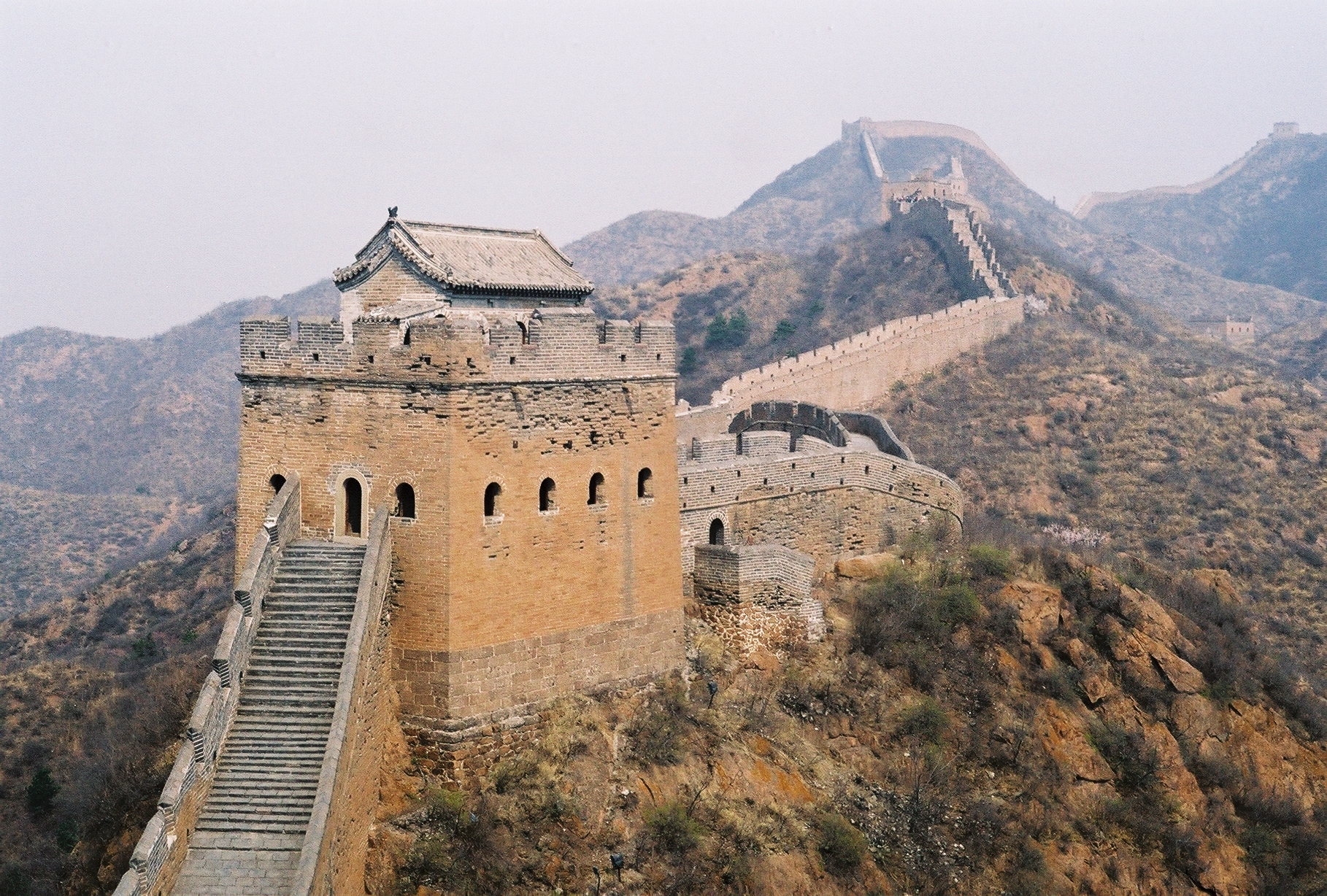
File:Jinshangling2.jpg
Great wall of China. Thanks Wikipedia.

 Today we see the remains of warring, turbulent ages in the form of the majestic castles of Germany, France and England, the Great Wall of China, Hadrian’s Wall in Scotland, even the Acropolis in Athens. These iconic fortifications now help to form a national identity; they speak to a shared heritage and remain as symbols, sometimes painful ones, of pivotal points in a nation’s development. While these fortifications were useful in their own time, almost all were overrun by superior technologies or ceased fulfilling their intended purposed due to diplomatic resolutions.
Edinburgh Castle, Scotland. Thanks Wikipedia.

Military infrastructure, like built work of any kind, is a cultural barometer. The materials used, the methods employed, all illuminate the greater political forces at work, and can even point to the source of conflict. The Castles and Fortresses of Medieval Europe, adorned with Christian imagery, speak not only to a time of adherent devotion to faith, but also to the wars being waged amongst Christian kings, each proclaiming divine right to rule.
Similarly, CHUs (containerized-housing-units), blast walls, fields of storage tanks, sallyports and bunkers all speak not only to the style of war being fought, but also to the resources and capabilities of the opposing forces. The physical presence of our military is indicative of a globalized force. Support systems are all containerized, ready for shipment to any corner of the globe. Bases are a package of components, each ready to plug-and-play in rapid deployment. And while these technological advances allow for the economical fabrication of miniature cities, they have come to demonstrate the kind of commercialization that has overrun our culture and permeated the military. In parts of the world where vast open land is part of tribal heritage and western notions of land owenership are foriegn, the imported 'Wal-Mart-esque' sprawl of bases and facilites convey a message of 'land-grabbing'. All of this is the result of a quick-fix mindset (the “surge” anyone?); whereas less economical solutions might prompt the more thoughtful allocation of resources, and greater emphasis on long-term strategic vision. Most importantly, we could leave a light footprint, and meaningful physical legacy; indicative of a country that respects the sovereignty of other nations and respects the future of its own image.
http://en.wikipedia.org/wiki/Hesco_bastion
Thanks: US Navy

  The Romans built castras, the source of the word “castle”, many of which served not only as military outposts, but also as centers of trade, and provided the foundations of great cities around the Mediterranean and throughout Europe. Then again, maybe a comparison to the most notorious empire in history is not a good place to start a discussion on modern American diplomacy. The fact remains, the Roman Empire spread language, learning, governance, and commerce in a way never before witnessed. Starting to sound like familiar foreign policy? And the staying power of their outposts is evidenced by the great cities that sit atop their foundations today.
Roman "castra" - this one failed to become anything greater than a fort.
A view into the future?
http://en.wikipedia.org/wiki/Castra

Regardless of our best diplomatic efforts, oratory and written resolutions have little staying power in the lives of those affected by conflicts. The places built, and things left behind will influence their collective feelings towards a foreign force that came in the name of peace and prosperity.

http://en.wikipedia.org/wiki/File:Camp_marmal02.JPG

These ideas are too readily dismissed as phenomenology, when in fact there is an undeniable truth that the built environment speaks; and is much longer-winded than even the most verbose politician.

More on this to come…