Showing posts with label history. Show all posts

Wednesday, January 4, 2012

Urban Decay - a critical curiosity


Baltimore, MD - Fall 2009

The recent swell of interest in urban decay has fascinated me for a few years now. As a student studying urban planning and design, it was all the rage. It has become the subject of innumerable budding photographers, graffiti artists, architects, urban explorers, and anyone interested in urban land. I have since taken a step back to critically examine this particular trend.  

"Why?" you ask. Why the fascination with the morbidity of the built environment?

Urban decay touches upon a myriad of modern conditions, both personal and environmental: 
-     They allow us to imagine one version of the future.


-     They satisfy a need for danger and risk, both perceived and real


-     They attract us with the fantasy of the unknown and foreign


-     They connect us to histories - some familiar, some unrelated to our own


-     They collect their own users and inhabitants - wildlife, artists, explorers, delinquents, recluses, etc.

The Roman Froum - Summer 2008
 Urban decay was initially fascinating to me because it is a very dynamic intersection between man and nature.


“Is it a building in the woods, or are the woods now in the building?”


I like the grey areas; where you can’t quite tell where the pavement ends, where the surface beneath your feet is an accumulation of time.

Landschaftspark - Duisburg Nord, Germany - Summer 2008
If you have ever come across, or had the chance to explore one of these places, they are intoxicating for the imagination. Ever dream of finding an ancient Mayan city, like Indiana Jones? Just like the subjects of Dr. Jones’ studies, that is precisely what these places are – artifacts. Rich with clues, treasures (objectively speaking), and hints of a life we may find it hard to imagine.


For western culture, a romanticism of the old begins at the Renaissance. As learning and the arts retuned to a Europe slowly crawling out of a dark hole, they looked to the only signs of civilization they knew, the Roman ruins. Being that these ruins pepper the countryside of Europe, and in many cases actually provided the foundation for the modern cities we know today, it was a natural curiosity that drove these early thinkers into the rubble.


The Roman Forum - Summer 2008
At the dawn of the 20th century, rising nationalism, combined with a yearning for a simpler past in hard times (the industrial revolution had begun to lose its novelty in Europe after the first “mechanized war”, WWI) brought about a renewed interest in the castles and the lore of old. Romanticized and politically tinged, ruins provided a physical rallying point, and metaphor, for supremacist ideologies - not to name names.


But, of course, all of this is Euro-centric, and fails to address the complex relationship between Americans and our “virgin land”. One could understand the lure of a place where no grand ruins existed to be claimed by one party or another as their entitlement to the land. And while the Native Americans left no stone arches or viaducts, their monumental works, be it the earthen mounds of the Mississippi people or Mayan jungle cities, were summarily dismissed by early settlers. In this land without a strong physical legacy of civilization, ruins were anomaly and despised by the “cult of the new.”


American values forsake the old for the new. We are a culture of the latest-and-greatest – and that subject alone could fill many volumes. For there to be a recent interest in the abandoned places of old, for me, points to a certain cultural maturity. This type of introspective reflection could be said to be indicative of a society trying to find its way, of a people attempting to reconnect to a “golden era”, or just a fad interest in destruction.


Abandoned places are indicative of LOST value. At one point, the decrepit warehouse, vacant lot, or rotting shell of a building was someone's great investment. The place held promise, its structures were dreamed of, labored over, and then occupied. 

Underground at the McMillan Water Filtration Plant - Washington D.C.

Today we find these structures and landscape on the front lines of the battle against time. Nature creeps in to reclaim walls and roofs for photosynthesis. Materials, assembled and sorted for the needs of man, begin the slow process of redistribution with the help of fungus, plants, insects, weathering and gravity. Like glaciated moonscapes, asphalt and concrete swaths are colonized at first by the simplest of organisms, graduating through time to support a complex ecosystem. To witness this process in action is to witness life at its most virile. It is in, and on, these abandoned places that the pioneers are engaged in a race to claim new territory. Generally, buildings, while occupied, and their accompanying lots have a dearth of biodiversity. Imagine them as the opposite of an oasis - a dead zone, like a lava flow. But as human use and upkeep (the constant energy inputs to keep entropy at bay) desist, the “wild" spills back in. 


Baltimore, MD - Fall 2009


What was once the fate of urban industrial activity has now spread to our malls, shopping centers and even our neighborhoods. The pendulum has swung. And so it is that the phenomenon of decay has become entered into many places it was formerly unheard of - but isn’t that the way it always is?


Survival in the urban desert - thriving under a roof drain. 
In the 1970’s and 1980’s, as the cores of America’s great urban centers rotted away, we busied ourselves shielding our lives from the realities of living in a post-industrial country. With a renewed interest in urban living, money has returned to many cities spurring investment and redevelopment. After the business districts are restored the next stop for the urban land speculators are the formerly industrial areas of a city. The examples are endless – of factory lofts, warehouse retail outlets, complete with exposed piping and ductwork. Some might argue that the abandoned factories of the late 20th century are becoming a rarity in many of the places they were made iconic.


These places are contradictions. In one way they illuminate the past, and in another they are prescient of the future. They are both foreign and familiar. They are created by loss and misfortune, yet continue to inspire. When viewed through the right lens, they can be spaces of opportunity. In our current times improving upon the existing, reusing materials previously harvested and processed, and up-cycling the frameworks we have inherited must be part of any comprehensive plan for future growth.

McMillan Water Filtration Cisterns and Sand Silos - Washington D.C.
In the end, whatever it may look like, a certain segment of people will always wonder with fascination at the places of man being overcome by time and natural forces. To create and build is to take a stab at immortality. In witnessing the erasure of the work of others we are humbled and reminded of our own inevitable decline.

Thursday, September 29, 2011

Physical Diplomacy

(The anniversary of 9/11 brought about a flood of emotion. The media forced us to replay that day; it took me back to being 14 – a sophomore in high school – and the wild range of emotions this new, shocking event evoked. My 9/11 (2011) started with a little NPR that resulted in much soul-searching, and ultimately I resorted to driving in silence with my thoughts.)
Maybe we lack, as a nation, a certain type of vanity. The kind that would cause us to pause and consider what the rest of the world thinks of us. There are plenty of voices screaming, “who cares!?” And while that may not be the official line towed by our noble diplomats, it is the voice of our physical legacy in the places we have entered in the name of peace and stability.
Field of abandoned blast-walls - Iraq
Courtesy: http://gocomics.typepad.com/the_sandbox/2008/08/graveyard-of-ol.html

BLDGBLOG ran a timely post on 9/11(http://bldgblog.blogspot.com/2011/09/shape-of-war.html). Studio-X NYC hosted a discussion with photographer Simon Norfolk, focused on the spaces and technologies of post-9/11 warfare. While the discussion will surely explore the photographic qualities of such surreal places, and their modern implications, I would like to look at these new battlefields in the context of future diplomacy.
The physical works of militaries are some of the longest standing and most iconic on earth. We humans have a violent history; there is no doubt about that, and the infrastructure of conquest, control, and defense has long shaped our understanding of nations. The very need to build, the root of architecture, was to protect one’s self from the elements, the beasts, and inevitably, one’s neighbors.
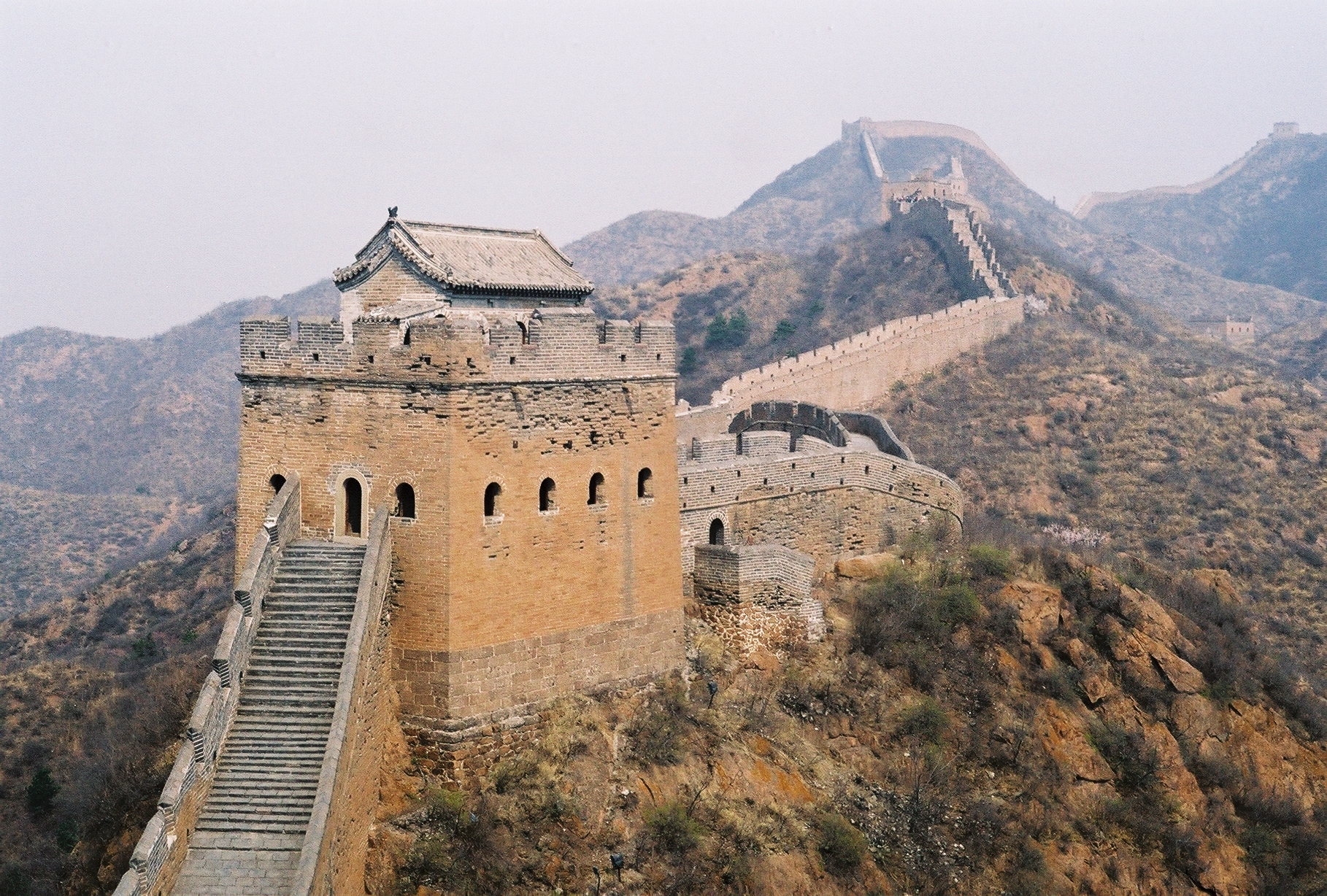
File:Jinshangling2.jpg
Great wall of China. Thanks Wikipedia.

 Today we see the remains of warring, turbulent ages in the form of the majestic castles of Germany, France and England, the Great Wall of China, Hadrian’s Wall in Scotland, even the Acropolis in Athens. These iconic fortifications now help to form a national identity; they speak to a shared heritage and remain as symbols, sometimes painful ones, of pivotal points in a nation’s development. While these fortifications were useful in their own time, almost all were overrun by superior technologies or ceased fulfilling their intended purposed due to diplomatic resolutions.
Edinburgh Castle, Scotland. Thanks Wikipedia.

Military infrastructure, like built work of any kind, is a cultural barometer. The materials used, the methods employed, all illuminate the greater political forces at work, and can even point to the source of conflict. The Castles and Fortresses of Medieval Europe, adorned with Christian imagery, speak not only to a time of adherent devotion to faith, but also to the wars being waged amongst Christian kings, each proclaiming divine right to rule.
Similarly, CHUs (containerized-housing-units), blast walls, fields of storage tanks, sallyports and bunkers all speak not only to the style of war being fought, but also to the resources and capabilities of the opposing forces. The physical presence of our military is indicative of a globalized force. Support systems are all containerized, ready for shipment to any corner of the globe. Bases are a package of components, each ready to plug-and-play in rapid deployment. And while these technological advances allow for the economical fabrication of miniature cities, they have come to demonstrate the kind of commercialization that has overrun our culture and permeated the military. In parts of the world where vast open land is part of tribal heritage and western notions of land owenership are foriegn, the imported 'Wal-Mart-esque' sprawl of bases and facilites convey a message of 'land-grabbing'. All of this is the result of a quick-fix mindset (the “surge” anyone?); whereas less economical solutions might prompt the more thoughtful allocation of resources, and greater emphasis on long-term strategic vision. Most importantly, we could leave a light footprint, and meaningful physical legacy; indicative of a country that respects the sovereignty of other nations and respects the future of its own image.
http://en.wikipedia.org/wiki/Hesco_bastion
Thanks: US Navy

  The Romans built castras, the source of the word “castle”, many of which served not only as military outposts, but also as centers of trade, and provided the foundations of great cities around the Mediterranean and throughout Europe. Then again, maybe a comparison to the most notorious empire in history is not a good place to start a discussion on modern American diplomacy. The fact remains, the Roman Empire spread language, learning, governance, and commerce in a way never before witnessed. Starting to sound like familiar foreign policy? And the staying power of their outposts is evidenced by the great cities that sit atop their foundations today.
Roman "castra" - this one failed to become anything greater than a fort.
A view into the future?
http://en.wikipedia.org/wiki/Castra

Regardless of our best diplomatic efforts, oratory and written resolutions have little staying power in the lives of those affected by conflicts. The places built, and things left behind will influence their collective feelings towards a foreign force that came in the name of peace and prosperity.

http://en.wikipedia.org/wiki/File:Camp_marmal02.JPG

These ideas are too readily dismissed as phenomenology, when in fact there is an undeniable truth that the built environment speaks; and is much longer-winded than even the most verbose politician.

More on this to come…

Friday, August 5, 2011

A bit of history...


----- "The US standard railroad gauge (distance between the rails) is 4 feet, 8.5 inches. That's an exceedingly odd number.


Why was that gauge used? Because that's the way they built them in England, and English expatriates built the US railroads.


Why did the English build them like that? Because the first rail lines were built by the same people who built the pre-railroad tramways, and that's the gauge they used.


Why did 'they' use that gauge then? Because the people who built the tramways used the same jigs and tools that they used for building wagons, which used that wheel spacing.


Why did the wagons have that particular odd wheel spacing? Well, if they tried to use any other spacing, the wagon wheels would break on some of the old, long distance roads in England, because that's the spacing of the wheel ruts.


So who built those old rutted roads? Imperial Rome built the first long distance roads in Europe (and England) for their legions.
And the ruts in the roads? Roman war chariots formed the initial ruts, which everyone else had to match for fear of destroying their wagon wheels. Since the chariots were made for Imperial Rome, they were all alike in the matter of wheel spacing.


Therefore the United States standard railroad gauge of 4 feet, 8.5 inches is derived from the original specifications for an Imperial Roman war chariot. Bureaucracies live forever.


So the next time you are handed a specification, procedure, or process and wonder 'What horse's ass came up with it?', you may be exactly right. Imperial Roman army chariots were made just wide enough to accommodate the rear ends of two war horses. Now, the twist to the story:


When you see a Space Shuttle sitting on its launch pad, there are two big booster rockets attached to the sides of the main fuel tank. These are solid rocket boosters, or SRB's. The SRB's are made by Thiokol at their factory in Utah. The engineers who designed the ferred to make them wider, but the SRB's had to be shipped by train from the factory to the launch site.


The railroad line from the factory happens to run through a tunnel in the mountains, and the SRB's had to fit through that tunnel. Thtunnel is slightly wider than the railroad track, and the railroad track, as you now know, is about as wide as two horses' behinds.So, a major Space Shuttle design feature of what is arguably the world's most advanced transportation system was determined over two thousand years ago by the width of a horse's ass" -----


This is a repost from some other source- I have no idea where this came from or who wrote it first. It was emailed to me by one of my favorite professors during my final year at VT.
While being an interesting history lesson, it also illustrates how the standards, sizes and constraints we accept with curious bewilderment each day have long and storied evolutions. 

My personal daily example is the metric/english system...mess. That is really the only way to describe it, a mess. In our modern work we are beholden to these dualing, unrelated measurement systems. I'm going out on a limb here - I'm blaming this one on architects. Every architect I know loves the english system. They are enamored with their 5/8ths and 3/32nds, Ive never met another group of people so loyal to compound fractions. Nearly every day I coordinate with an architect who gives me files in english while every other engineer gives me files in metric. Everything is finalized in metric anyways, so why use the english system to begin with? Because projects have lead architects, not lead engineers, or landscape architects. And when the project is done, its the architects name that goes on it - the same guy who was too troubled to work in the same universe as the other 98% of the world. The examples are endless; of huge errors, 10 million dollar mistakes, and so much time wasted, neither system has a unit to describe it, all because of a few American architects who still go by the length of a dead king's hand, or finger, or whatever it was.

Who knows, you could be setting a precedent today that will have people 2,000 years from now scratching their heads and cursing your name..