In my quest to stay on top of emerging trends, and just keep up on news in areas that interest me, I subscribed to Google Alerts.
Now, after a few months of "alerts", I have a sizeable collection of articles, resources, and internet detritus - its a mixed blessing. The articles are mostly gleaned from periodicals, online publications, and local newspapers. I get news on suburban agriculture from all over the place, and in every context. The result - a nation-wide perspective of a locally-focused trend. Every town, city, county, and state is addressing food, and land in a new light, specific to their own concerns and each facing its own challenges. The picture that is peiced together is one of ingenuity, resilience, and people working hard to change the status quo. No matter what BigAg says, its clear people are beginning to understand that a diet based mostly on corn byproducts (whether consumed whole or fed to livestock to be consumed) can't be very good for you. At a minimum, people are interested - interested in how thing grow, and what they can do themselves.
So, here, today, I present to you a filtering (wide mesh) of the vast haul google has trawled from the internet for me.
I will add a very brief description for each, and I will try to make this a more regular thing to avoid the build-up Im dealing with now.
Enjoy!
Chicago - Subruban Moms meet framers to discuss farm practices and learn about agriculture
http://wjbc.com/suburban-moms-meet-up-with-farmers-in-chicago/
Kentucky - Dr. David Wicks lists 21 ways to green a city
http://blogs.courier-journal.com/davidwicks/2011/12/01/true-green-21-ways-to-plant-a-city/
Cuba - Suburban Agricultrure dry season production
http://www.cadenagramonte.cu/english/index.php?option=com_content&task=view&id=8367&Itemid=14
- further reading
http://www.radiorebelde.cu/english/news/cattle-raising-in-suburban-agriculture-20111201/
Michigan - Placemaking in conjunction with urban agriculture to rebuild declining industrial cities in the midwest. "Creating 21st century communities"
http://rustwire.com/2011/11/29/can-placemaking-save-michigan/
New Jersey (in the future) - A slightly bizzare, fictional account of what shopping might be like in 2021 in northern New Jersey, need I say more?
http://www.zdnet.com/blog/perlow/retail-in-2021-when-clicks-have-buried-bricks/19344
Detroit - Urban farms exempted from traditional farming laws. BigAg - not happy.
http://www.freep.com/article/20111128/NEWS06/111280346/Bill-would-create-Right-Farm-Act-exemption-Detroit?odyssey=nav%7Chead
NRDC, National - House prices slump+Food prices rise = suburbs reverting to, or integrating, farming.
http://switchboard.nrdc.org/blogs/kbenfield/back_to_the_farm_subdivision_l.html
Indiana - Future Farmers of America (FFA) expands scope and stays relevant!
http://www.ocala.com/article/20111111/ZNYT01/111113011?p=2&tc=pg
Maine - finding the space to encourage suburban/small scale farming in built up areas.
http://www.kjonline.com/opinion/protecting-encouraging-farming-must-start-at-the-local-level_2011-11-10.html
California - The fate of our fine friends Apis mellifera, aka. BEES!
http://www.scientificamerican.com/article.cfm?id=the-pollinator-crisis
Cuba - The suburban and urban ag. capital of the world!
http://www.cadenagramonte.cu/english/index.php?option=com_content&view=article&id=7997:cuban-urban-agriculture-an-emerging-alternative&catid=27:economy&Itemid=24
Oakland - The legal and neighborly hazards of urban farming. Oakland adjusts laws and ordinances to reflect rise in urban homesteading.
http://thinkprogress.org/romm/2011/11/07/362467/urban-homesteading-popular-trend/
More BEES! - Small-scale bee keepers may be the solution to colony-collapse disorder. Pending ordinances to facilitate
http://grayslake.patch.com/articles/local-beekeepers-may-play-role-in-saving-food-supply-e34860c7
*MUST READ* - Small cities are the place to be post-oil
http://www.grist.org/cities/2011-10-31-why-small-cities-are-poised-for-success-in-an-oil-starved-future

Friday, December 9, 2011


Monday, November 28, 2011
PORTFOLIO - done for the moment...
Im sure there will be many more iterations to come. view as spreads.
Feedback is welcome, enjoy!
Feedback is welcome, enjoy!
Thursday, November 24, 2011
Drawings from my senior project
 |
| First in set of 3. Led to some great design discoveries. |
Found these while assembling and editing the latest round of my portfolio.
They were all drawn in late 2009 and early 2010, for my senior project - The Estuary District. They are a mix of site analysis, concept development, and the general working out of ideas.
Enjoy -
 |
| 2 of 3 |
 |
| 3 of 3 ... discovery! |
 |
| What do I have to work with? What does it want to be? |
 |
| What do I want it to be? |
 |
| What grows here now? How does it do it? |
 |
| How did these buildings function? |
 |
| Whats going on underground? What could that become? |
Sunday, October 30, 2011

Wednesday, October 19, 2011
New blogs and website links
Here are a few of the new website and blogs that I’m following. You can also find them now in the sidebar!
If anyone has any others they highly recommend – I’m always interested.
Enjoy!
An exploration of what makes old cities work and how we can apply that to the cities of today.
If anyone has any others they highly recommend – I’m always interested.
Enjoy!
An exploration of what makes old cities work and how we can apply that to the cities of today.
The intersection of capitalism and urbanism.
A look at the policies and ‘best practices’ guiding the development of modern cities.
Environmental news, sustainable home-ec, DIY projects, and a dash of politics.
Friday, October 7, 2011
Steve Jobs quotes
I have discovered a few interesting quotes from Mr. Jobs over the past few days, and some great writing about his influence on things such as leadership, design, innovation, and consumerism. I'll continue to add to this post as I find them.
Enjoy -
Enjoy -
Thursday, September 29, 2011
Physical Diplomacy
(The anniversary of 9/11 brought about a flood of emotion. The media forced us to replay that day; it took me back to being 14 – a sophomore in high school – and the wild range of emotions this new, shocking event evoked. My 9/11 (2011) started with a little NPR that resulted in much soul-searching, and ultimately I resorted to driving in silence with my thoughts.)
Maybe we lack, as a nation, a certain type of vanity. The kind that would cause us to pause and consider what the rest of the world thinks of us. There are plenty of voices screaming, “who cares!?” And while that may not be the official line towed by our noble diplomats, it is the voice of our physical legacy in the places we have entered in the name of peace and stability.
 |
| Field of abandoned blast-walls - Iraq Courtesy: http://gocomics.typepad.com/the_sandbox/2008/08/graveyard-of-ol.html |
BLDGBLOG ran a timely post on 9/11(http://bldgblog.blogspot.com/2011/09/shape-of-war.html). Studio-X NYC hosted a discussion with photographer Simon Norfolk, focused on the spaces and technologies of post-9/11 warfare. While the discussion will surely explore the photographic qualities of such surreal places, and their modern implications, I would like to look at these new battlefields in the context of future diplomacy.
The physical works of militaries are some of the longest standing and most iconic on earth. We humans have a violent history; there is no doubt about that, and the infrastructure of conquest, control, and defense has long shaped our understanding of nations. The very need to build, the root of architecture, was to protect one’s self from the elements, the beasts, and inevitably, one’s neighbors.
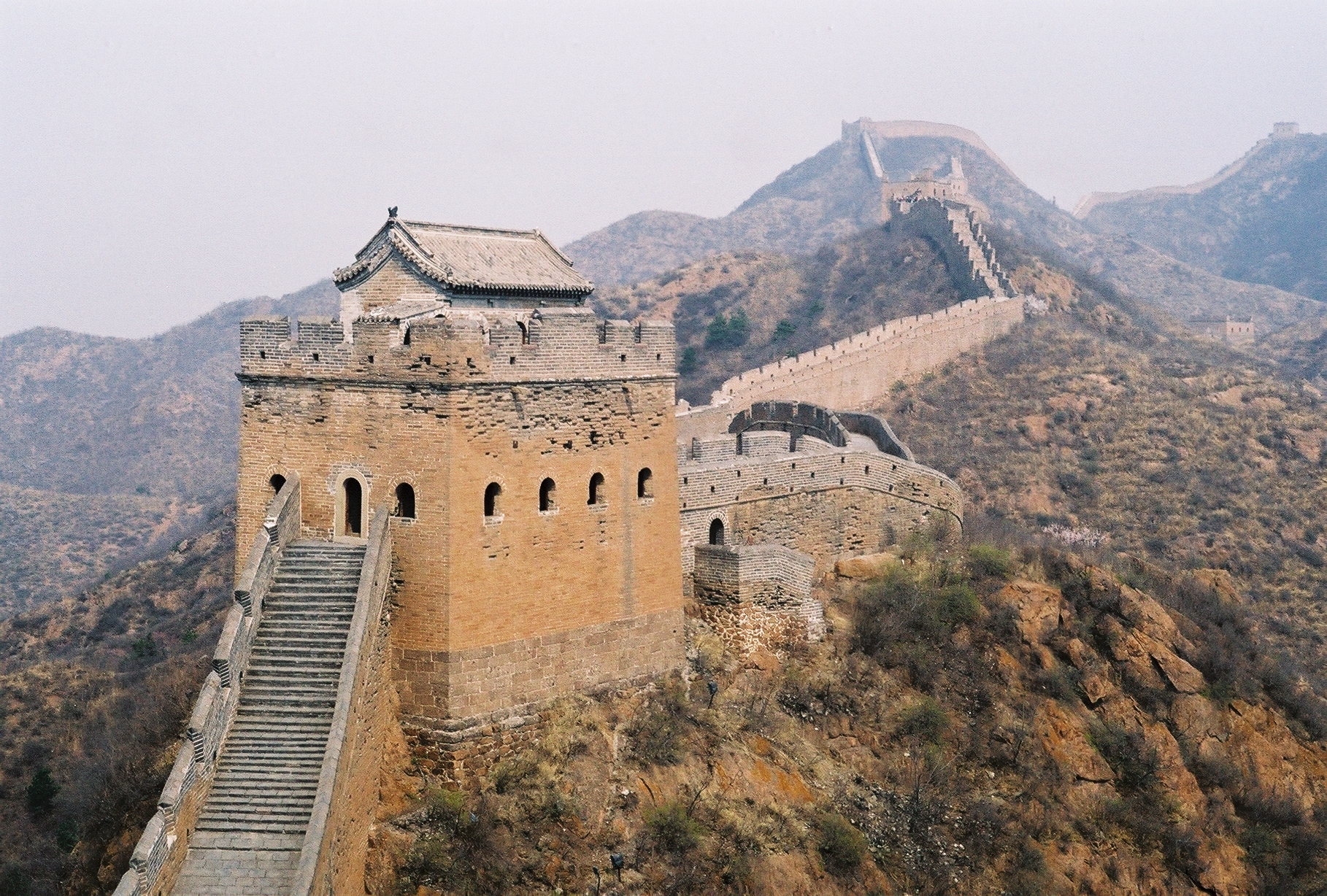 |
| Great wall of China. Thanks Wikipedia. |
Today we see the remains of warring, turbulent ages in the form of the majestic castles of Germany, France and England, the Great Wall of China, Hadrian’s Wall in Scotland, even the Acropolis in Athens. These iconic fortifications now help to form a national identity; they speak to a shared heritage and remain as symbols, sometimes painful ones, of pivotal points in a nation’s development. While these fortifications were useful in their own time, almost all were overrun by superior technologies or ceased fulfilling their intended purposed due to diplomatic resolutions.
 |
| Edinburgh Castle, Scotland. Thanks Wikipedia. |
Military infrastructure, like built work of any kind, is a cultural barometer. The materials used, the methods employed, all illuminate the greater political forces at work, and can even point to the source of conflict. The Castles and Fortresses of Medieval Europe, adorned with Christian imagery, speak not only to a time of adherent devotion to faith, but also to the wars being waged amongst Christian kings, each proclaiming divine right to rule.
Similarly, CHUs (containerized-housing-units), blast walls, fields of storage tanks, sallyports and bunkers all speak not only to the style of war being fought, but also to the resources and capabilities of the opposing forces. The physical presence of our military is indicative of a globalized force. Support systems are all containerized, ready for shipment to any corner of the globe. Bases are a package of components, each ready to plug-and-play in rapid deployment. And while these technological advances allow for the economical fabrication of miniature cities, they have come to demonstrate the kind of commercialization that has overrun our culture and permeated the military. In parts of the world where vast open land is part of tribal heritage and western notions of land owenership are foriegn, the imported 'Wal-Mart-esque' sprawl of bases and facilites convey a message of 'land-grabbing'. All of this is the result of a quick-fix mindset (the “surge” anyone?); whereas less economical solutions might prompt the more thoughtful allocation of resources, and greater emphasis on long-term strategic vision. Most importantly, we could leave a light footprint, and meaningful physical legacy; indicative of a country that respects the sovereignty of other nations and respects the future of its own image.
 |
| http://en.wikipedia.org/wiki/Hesco_bastion Thanks: US Navy |
The Romans built castras, the source of the word “castle”, many of which served not only as military outposts, but also as centers of trade, and provided the foundations of great cities around the Mediterranean and throughout Europe. Then again, maybe a comparison to the most notorious empire in history is not a good place to start a discussion on modern American diplomacy. The fact remains, the Roman Empire spread language, learning, governance, and commerce in a way never before witnessed. Starting to sound like familiar foreign policy? And the staying power of their outposts is evidenced by the great cities that sit atop their foundations today.
 |
| Roman "castra" - this one failed to become anything greater than a fort. A view into the future? http://en.wikipedia.org/wiki/Castra |
Regardless of our best diplomatic efforts, oratory and written resolutions have little staying power in the lives of those affected by conflicts. The places built, and things left behind will influence their collective feelings towards a foreign force that came in the name of peace and prosperity.
 |
| http://en.wikipedia.org/wiki/File:Camp_marmal02.JPG |

These ideas are too readily dismissed as phenomenology, when in fact there is an undeniable truth that the built environment speaks; and is much longer-winded than even the most verbose politician.
More on this to come…
Subscribe to:
Posts (Atom)